Carajillo Recipe:
The Authentic Spanish Coffee Cocktail
Rich espresso meets silky Licor 43 — Spain’s most beloved coffee cocktail, made easy at home in under 5 minutes.
Imagine this: you are sitting at a small café in Barcelona. The waiter brings you a glass — golden liqueur swirling under a dark layer of fresh espresso, floating on ice. You take a sip. It is bold, smooth, slightly sweet, and completely unforgettable. That is a carajillo.
The carajillo drink has been around for over a century, loved across Spain, Mexico, and Latin America. But in 2026, it has exploded worldwide — popping up in cocktail bars, coffee shops, and home kitchens everywhere. And the best part? You only need two main ingredients and five minutes.
Whether you want the classic Mexican carajillo with Licor 43, a traditional Spanish hot carajillo, or a non-alcoholic mocktail version — this guide has everything you need. Let’s make it.
What is a Carajillo? (History & Meaning)
A carajillo is a traditional Spanish coffee cocktail made by combining a shot of espresso with a spirit — most commonly Licor 43, brandy, or rum. It is served either hot (the original Spanish way) or iced (the popular modern Mexican style). The name comes from the Spanish word coraje, meaning “courage.”
The Story Behind the Name
One of the most popular stories about the carajillo origin goes back to the 19th century. Spanish soldiers stationed in Cuba would mix their coffee with rum to give themselves un poco de coraje — a little bit of courage — before battle. Over time, the drink traveled back to Spain and became a beloved café staple.
Another version of the carajillo history says it began among dock workers and laborers in Barcelona who needed a warm, energizing drink to start their long shifts. A shot of brandy in hot coffee was practical, affordable, and delicious.
How the Mexican Carajillo Became Famous
The Spanish carajillo traditionally used brandy. But when the drink traveled to Mexico, bartenders discovered that Licor 43 — a Spanish vanilla-citrus liqueur — paired beautifully with espresso. The Mexican carajillo with Licor 43, served iced and layered, became a sensation. Today it is arguably the most Googled and most-ordered version of the drink worldwide.
Classic Carajillo Recipe (The One You Need)
This is the authentic Mexican carajillo recipe — iced, layered, and made with Licor 43. It is the version that has taken the world by storm, and once you make it at home, you will never pay café prices again.
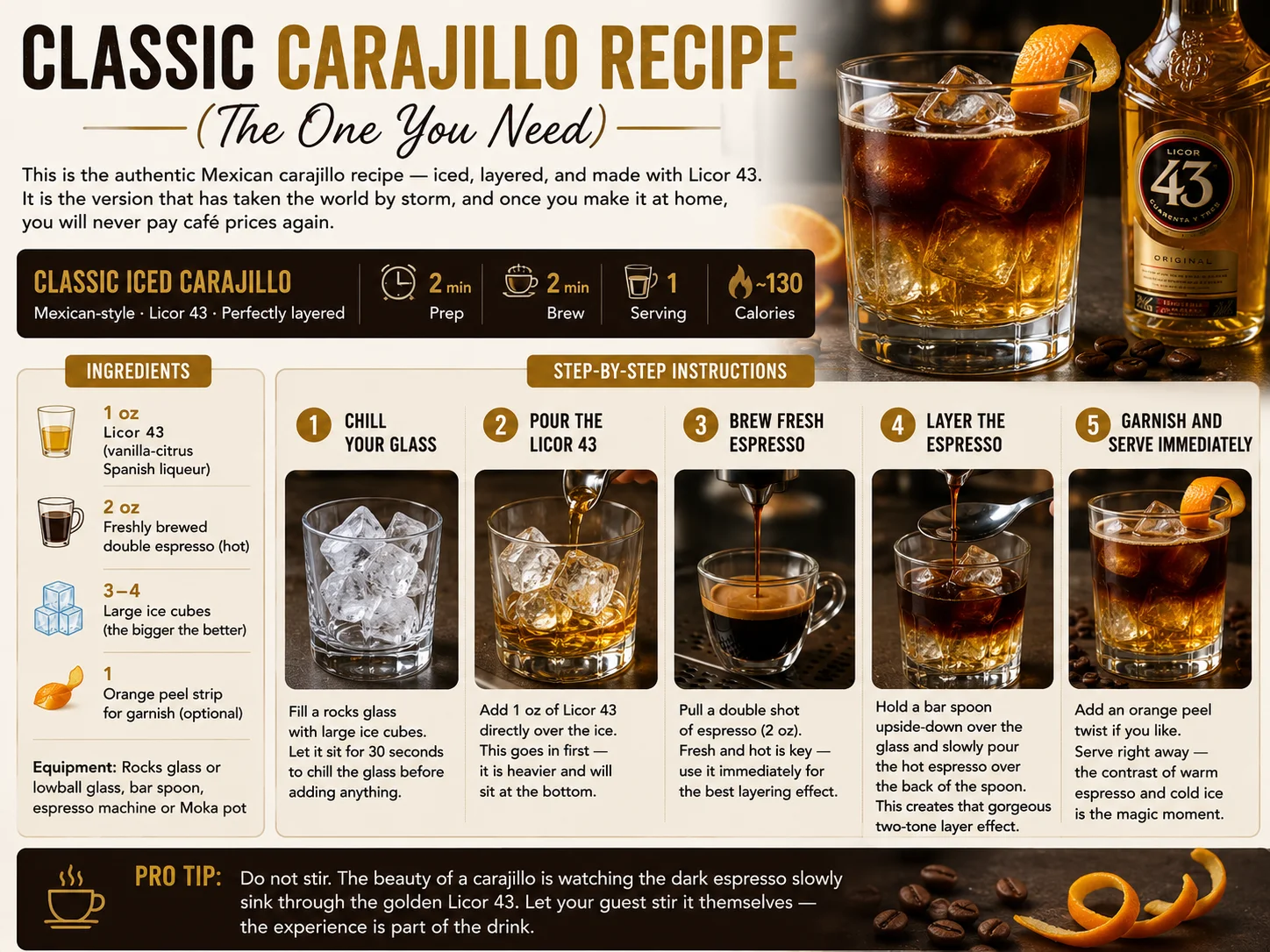
- 1 oz Licor 43 (vanilla-citrus Spanish liqueur)
- 2 oz Freshly brewed double espresso (hot)
- 3–4 Large ice cubes (the bigger the better)
- 1 Orange peel strip for garnish (optional)
-
1Chill your glass Fill a rocks glass with large ice cubes. Let it sit for 30 seconds to chill the glass before adding anything.
-
2Pour the Licor 43 Add 1 oz of Licor 43 directly over the ice. This goes in first — it is heavier and will sit at the bottom.
-
3Brew fresh espresso Pull a double shot of espresso (2 oz). Fresh and hot is key — use it immediately for the best layering effect.
-
4Layer the espresso Hold a bar spoon upside-down over the glass and slowly pour the hot espresso over the back of the spoon. This creates that gorgeous two-tone layer effect.
-
5Garnish and serve immediately Add an orange peel twist if you like. Serve right away — the contrast of warm espresso and cold ice is the magic moment.
Tips for the Perfect Carajillo Every Time
The carajillo recipe is simple, but a few small details separate a good one from a great one. Here is what actually matters:
Espresso is 67% of your drink. Freshly ground beans, properly extracted, make an enormous difference. Aim for a dark-medium roast with low acidity.
Large ice cubes melt slower, so your drink stays concentrated and cold without getting watered down. Avoid crushed ice for iced carajillo.
The classic carajillo ratio is 1:2 — one part spirit to two parts espresso. If you want it sweeter, go 1:1. Stronger? Keep the ratio and use a ristretto shot.
Licor 43 gives a sweet, vanilla-forward flavor. Brandy is drier and more traditional. Rum adds tropical warmth. Kahlúa doubles the coffee intensity. All work — just different experiences.
A rocks glass (lowball) is ideal for iced carajillo. It shows off the layering beautifully. For hot carajillo, a small glass mug or a cortado glass works perfectly.
An orange peel is the classic carajillo garnish. Squeeze it over the glass first to release the oils, then drop it in. It adds a bright citrus note that lifts the whole drink.
Carajillo Variations: Every Version You Need to Know
The beauty of the carajillo cocktail is how versatile it is. Once you know the base formula, you can adapt it to any occasion, any spirit, and any preference. Here are the most popular variations:
How to Make Carajillo Without an Espresso Machine
Do not have an espresso machine at home? No problem. The carajillo recipe works beautifully with several alternative brewing methods. Here is what to use:
Moka Pot (Best Alternative)
A Moka pot brews coffee at a similar pressure to espresso and produces a strong, concentrated result that works perfectly in a carajillo. Use fine-ground dark roast coffee, fill the basket completely, and brew on medium-low heat. The result is almost identical to a proper espresso shot.
AeroPress (Great for Travel)
The AeroPress can make a concentrated espresso-style coffee that works wonderfully. Use 20g of fine-ground coffee with 60ml of water at 85°C (185°F), steep for 2 minutes, and press slowly. Strong, smooth, and clean.
Instant Coffee Carajillo (Quickest Option)
For a quick carajillo at home, dissolve 2–3 teaspoons of a quality instant espresso powder (like Medaglia D’Oro or Nescafé Azera) in just 2 oz of hot water. It is not identical to fresh espresso, but it makes a perfectly decent carajillo in under 3 minutes.
Carajillo vs Other Coffee Drinks — What’s the Difference?
People often confuse the carajillo with other popular coffee cocktails. Here is a clear comparison so you always know what you are ordering or making:
| Drink | Base Spirit | Temperature | Technique | Flavor Profile |
|---|---|---|---|---|
| Carajillo | Licor 43 / Brandy / Rum | Iced or Hot | Layered, no shake | Sweet, vanilla, bold espresso |
| Espresso Martini | Vodka + Kahlúa | Chilled (shaken) | Shaken vigorously | Bitter, strong, frothy |
| Cortado | No alcohol | Hot | Espresso + steamed milk | Creamy, mild, no sweetness |
| Irish Coffee | Irish Whiskey | Hot | Coffee + cream float | Warm, creamy, slightly smoky |
| Café Bombon | No alcohol | Hot or Iced | Espresso + condensed milk | Very sweet, creamy, intense |
The main difference between a carajillo and an espresso martini is the technique and the base spirit. The carajillo is gentler — layered, not shaken — and usually sweeter and more approachable. The espresso martini is more intense and cocktail-forward.
How to Serve & Present a Carajillo
Best Glass for Carajillo
Use a rocks glass (lowball glass) for iced carajillo — it shows off the stunning two-tone layer of golden liqueur and dark espresso. For hot carajillo, a small glass mug or Spanish caña glass (a short narrow glass) is traditional and beautiful.
The Foam Question
Should a carajillo have foam? If you pour the espresso correctly — slowly over the back of a spoon while the crema is still fresh — you will naturally get a thin foam layer on top. This is the mark of a well-made carajillo. Some bartenders also use a milk frother to create a more pronounced carajillo foam for presentation.
Batch Carajillo Recipe (for Parties)
Making carajillo for a group? Scale up easily: mix 1 cup of Licor 43 with 2 cups of cooled espresso in a large pitcher. Refrigerate for up to 4 hours. When ready to serve, pour over ice in individual glasses. Works perfectly for brunch parties and dinner parties.
Seasonal Variations
In summer, serve your carajillo over a mountain of ice with a slice of orange — the iced carajillo summer version. In winter, serve it hot with a cinnamon stick and a small piece of dark chocolate on the side. For holiday gatherings, add a pinch of nutmeg and a drop of vanilla extract to the hot version for a festive Christmas carajillo twist.
Love coffee-inspired recipes? Check out another classic from our collection:
See the Full Kransekake Recipe — Norway’s Most Iconic Celebration Cake →Carajillo FAQ — Your Questions Answered
These are the most commonly asked questions about the carajillo drink. Clear, honest, and complete answers below:
A carajillo is a traditional Spanish coffee cocktail made with espresso and a spirit — most commonly Licor 43, brandy, or rum. It originated in Spain and became hugely popular in Mexico, where the Licor 43 iced version is now the most famous style worldwide.
The most popular carajillo uses Licor 43, a sweet Spanish vanilla-citrus liqueur (31% ABV). Traditional Spanish carajillo uses brandy. Cuban versions use dark rum. Modern variations include whiskey, vodka, tequila (Patrón carajillo), or Kahlúa. The spirit is flexible — the espresso stays constant.
A carajillo is moderately strong — typically around 15–18% ABV in the final glass. It is stronger than wine but much milder than a straight cocktail. The carajillo alcohol content is well-balanced: you taste the spirit but it does not overpower the coffee. The caffeine also adds to the energizing effect.
No — they are different drinks. An espresso martini is shaken vigorously with vodka and coffee liqueur, resulting in a frothy cocktail served in a martini glass. A carajillo is layered (not shaken), served in a rocks glass, and uses Licor 43 or brandy. The carajillo is simpler to make and has a sweeter, more balanced flavor.
Absolutely. A Moka pot is the best alternative — it produces strong, concentrated coffee very similar to espresso. An AeroPress also works well. In a pinch, dissolve 2–3 teaspoons of quality instant espresso powder in 2 oz of hot water. The flavor will not be identical, but the result is still a very enjoyable instant coffee carajillo.
A classic carajillo with 1 oz of Licor 43 has approximately 120–140 calories. Licor 43 contains about 100 calories per ounce. Espresso itself has almost zero calories. If you add milk or cream (carajillo con leche), add roughly 20–40 more calories depending on the amount and type of milk.
A carajillo with Licor 43 tastes like a sophisticated vanilla-coffee cocktail. The espresso brings bold bitterness and depth; the Licor 43 adds sweetness, vanilla, and a hint of citrus. The overall experience is smooth, slightly sweet, and warming — not aggressively boozy. Many people describe it as “coffee dessert in a glass.”
Use a dark to medium-dark roast espresso with low acidity. Colombian, Brazilian, or Ethiopian dark roasts work beautifully. The coffee needs to be strong enough to hold its own against the spirit — a ristretto shot (concentrated, small-volume espresso) is ideal. Always brew fresh; never use cold or old coffee for a carajillo.
Final Thoughts
The carajillo recipe is proof that the best things in life are often the simplest. Two main ingredients. Five minutes. A result that feels like you are sitting in a Barcelona café or a Mexico City rooftop bar.
Whether you make the classic Mexican carajillo with Licor 43, the traditional Spanish hot carajillo with brandy, or you experiment with whiskey, tequila, or a non-alcoholic version — the formula always works. Strong espresso meets a quality spirit, and magic happens in the glass.
Now you have everything you need: the authentic carajillo recipe, the pro tips, the variations, and the answers to every question. The only thing left to do is brew the espresso, pour the Licor 43, and enjoy. Salud.